Thursday, August 07, 2014

The Pond

Is clearing up, thanks to Marvin and his Marvelous Weed B Gone.


Almost no green, only reddish brown.


There is a little algae left around that willow tree on the far side.  George and Greg are hoping the will dies, but I like it.

Wednesday, August 06, 2014

History

I went to the Dr.yesterday just for a checkup.  I have thought I probably had high blood pressure, and now I have blood pressure meds.  I have to go back in two weeks to see if it is working.

I went back to work today.  We were snowed under all day.  We have an audit next week, so it will not get better until the end of next week at least.

Not much news.  It is hot again.

Kids start to school in two weeks.

Monday, August 04, 2014

Cemetery Work


We mowed the cemetery today.  George took the big mower down.  We still had to do over half of it with the push mower, but the big mower really made fast work of what he could get to.  It took us less than an hour and a half, when our best time before was about 3 or 4 hours.

Emmy thinks she did most of the work, cause she sat and in the truck and made sure no one made off with it while we mowed.


Sister ran the weed eater.  It looks pretty good now.  If it does not rain till fall, which is likely here, we will not have to mow again.  Last year it did not rain after June first.

Sunday, August 03, 2014

Considering a Bennett Springs State Park Float Trip, DON'T...

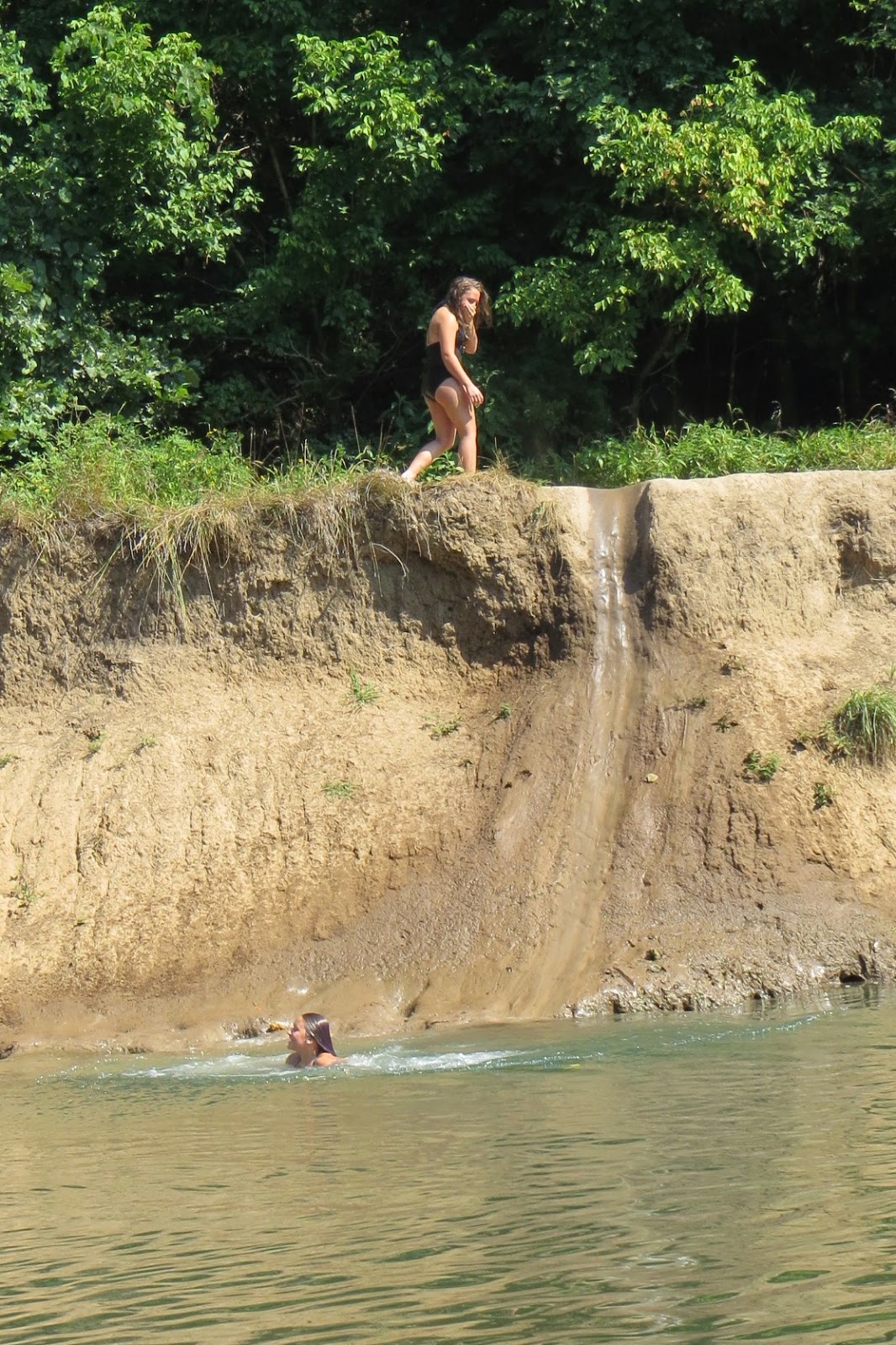
Friday we [George, me, Hannah, Robert, JR, Emmy, and Sam] drove up to Lebanon, MO to take a little float trip on the Niangua River.  We enjoyed the float on the Buffalo last month and wanted to try a new location, or new to us.  I know Winnie and Mike have a camper there and go fly fishing in the river a lot, so someone said I should ask her about the float.  But, I knew better because everything is on the web now.  Well, maybe I should have tried to get a little unbiased info from someone who knew the area.  The river was wonderful for floating, the area was beautiful, but on a Saturday in August, the river so really congested with hundreds of drunks in yellow rafts doing what drunks do, being loud and stupid. If you are looking for a place to take a family with children floating and are considering the Niangua, all I can say is Don't.

Actually, we did have a good time, but I just did not expect to see so many obviously highly intoxicated humans clogging the river to the point it was a challenge to even navigate through the blockades.  If this had been on the Buffalo, you could see pictures on the national news today of hundreds of people being carted off in paddy wagons.

Just take this as a warning, a float trip on the Niangua River on a Saturday in August is strictly  R rated.  Definitely not  a good family outing.

Still, we did all have fun.  And, the last two hours of the float, we had left all the drunks far upstream, providing an enjoyable time on the river.

And, the kids thought the best part of the trip was swimming in the motel pool till almost 10 each night.  I thought that was a little late for our two little one, but I decided to consider it summers last hurrah.


Thursday, July 31, 2014

Tent Caterpillers


Helen said she cut the tent caterpillars out of the trees in her yard today.  I asked if she burned them and she said yes because I told her to.  If you don't burn them, they will live on and produce many more worms next year.  I was trying to tell her that the worm was just one stage of their life cycle, and I thought the adult stage was a moth of some sort, but was not sure.  Now I know.

This is what the adult looks like.


The following description of the tent caterpillar life cycle is based on that of the eastern tent caterpillar, the best known species. The details of the life histories of other species vary to a small extent.
Tent caterpillars hatch from their eggs in the early spring at the time the leaves of their host trees are just unfolding. The caterpillars establish their tent soon after they eclose. The tent is constructed at a site that intercepts the early morning sun. The position of the tent is critical because the caterpillars must bask in the sun to elevate their temperatures above the cool ambient temperatures that occur in the early spring. Studies have shown that when the body temperature of a caterpillar is less than about 15 °C, digestion cannot occur. The tent consists of discrete layers of silk separated by gaps and the temperature in these compartments varies markedly. Caterpillars can adjust their body temperatures by moving from one compartment to another. On cool mornings they typically rest in a tight aggregate just under a sunlit surface of the tent. It is not uncommon to find that the temperature of the aggregate is as much as 30 °C (54 °F) warmer than the surrounding air temperature on cold but sunny spring mornings. Later on in the spring, temperatures may become excessive at midday and the caterpillars may retreat to the shaded outside surface of the tent to cool down.

 The digestive physiology of tent caterpillars is tuned to young leaves, and their need to complete their larval development before the leaves of the host trees become too aged for them to eat compels them to feed several times each day. At the onset of a bout of foraging, caterpillars leave the tent en masse, moving to distant feeding sites. Immediately after feeding the caterpillars return to the tent and aggregate in sunlight to facilitate the digestive process. Thus, eastern tent caterpillars are central place foragers. In contrast, the forest tent caterpillar is a nomadic forager that establishes a series of temporary resting sites during the course of its larval development.
Studies have shown that eastern tent caterpillars recruit their tent mates to go on food finds. Caterpillars move from the tent in search of food, laying down an exploratory pheromone trail as they pass over the branches of the host tree. These chemical exploratory trails allow caterpillars to find their way back to the tent. If a caterpillar finds food and feeds to repletion, it returns to the tent, laying down a recruitment trail that serves to recruit hungry tent mates to its food find. The chemical nature of the pheromone has been determined, but it is unclear how exploratory and recruitment trails differ. The chemical recruitment trail of the eastern tent caterpillar is remarkably similar to the pheromone trails that are used by ants and termites to alert nest mates to the discovery of food.
Leaves consist largely of nondigestible components, and it has been estimated that tent caterpillars void as fecal pellets nearly half of the energy they ingest. Consequently, a colony of caterpillars produces large quantities of fecal pellets. This is particularly noticeable during outbreaks of the forest tent caterpillar. Fecal pellets dropping from treetops in which the caterpillars are feeding create the auditory illusion of rainfall. Tent caterpillars typically have five to six larval instars. It is estimated that the last instar consumes about 80% of all the food taken in by a larva during the whole of its life cycle. Consequently, it is not uncommon for populations of forest tent caterpillars to go unnoticed until the last instar, when their feeding causes extensive defoliation of trees.
Caterpillars grow rapidly and typically complete their larval development in seven to eight weeks. When fully grown, the caterpillars leave the natal tree and seek protected places on the ground or under the eaves of buildings to spin their cocoons. About two weeks later, they emerge as adults. Shortly after eclosing from the cocoon, the female moth secretes a pheromone which draws males to her. Mating typically occurs in the early evening and the mated female, already fully laden with eggs, typically oviposits the full complement later that same evening. The eggs are placed around the circumference of a branch and covered with a frothy material called spumaline. Spumaline is hydrophilic and prevents the eggs from drying out. It also serves as a protective covering which limits the ability of small wasps to parasitize the eggs. Although the male moth may live for a week or more, the female dies soon after laying her eggs. Thus, the whole of the female's adult life may take place in fewer than 24 hours.

Shortly after the egg mass is deposited, embryogenesis begins. Within three weeks or so, small larvae can be found within each egg mass. These pharate larvae lie sequestered within the shells of the eggs until the following spring. Thus, these encased larvae are the most durable of the insect's life stages. In northern areas, the pharate larvae are highly freeze-tolerant and can withstand midwinter temperatures of −40 °C or lower.

Monday, July 28, 2014

Aunt Helen Sez

Robert, you cannot have a toy every time we go to the store.  Toys are for special occasions.  Greg, you should take them to the Dollar Tree and let them get one toy each.


Aunt Helen came home with this tonight.  Aunt Helen said, 'He did not have a cement truck.'


Papa built them a fire for roasting hot dogs and marshmallows.  They each ate 3 hot dogs and lots of marshmallows.  Here Robert's new cement truck has turned over.  He says, 'I know, I will get my crane and turn it back over.' 


Here he is working on hooking the crane to the mixer.


Here he has returned to eating hot dogs leaving Papa to work with the crane and mixer.  It is good to have 67 year old boy to play trucks with.


Hannah loves roasted marshmallows.


I saw two deer down in the field.  After snapping the picture, I see two spots of brown grass reflecting the sunlight.